
Total-cost-of-ownership tool
Raspberry Pi vs Mini PC Cost & Payback Calculator
Compare a Raspberry Pi 5 build against a ready-made mini PC on real money: 2026 board prices, measured watts, annual electricity and how long a price gap takes to pay back.
What this tool answers
The Pi-versus-mini-PC argument is almost always framed as a sticker-price fight, and almost always settled by the wrong number. A Raspberry Pi 5 board is cheap; a usable Pi build is not. The board needs a 27 W USB-C supply, cooling, a case and — for anything database-shaped — an M.2 HAT and an NVMe drive. This calculator puts the full build cost and the full electricity cost of both options side by side, then reports the only number that settles a price argument: how many years, if any, it takes the cheaper-to-run box to repay its higher purchase price.
The companion article, Raspberry Pi 5 vs Mini PC for a home server, covers workloads, transcoding and the RAM ceiling. This page covers money only.
The 2026 price reality
Raspberry Pi raised list prices across the Pi 4 and Pi 5 lines in 2026 to offset LPDDR4 memory costs, and most comparison articles still quote the old ones. The official November 2026 list prices are $55 (2 GB), $70 (4 GB), $95 (8 GB) and $145 (16 GB). A Pi 5 16 GB board alone now costs nearly three-quarters of a complete $200-class mini PC that already includes 16 GB of RAM, a 512 GB NVMe and a Windows licence.
The measured basis
| Side | Idle | Load | Basis |
|---|---|---|---|
| Mini PC (Beelink EQi12 preset) | 12 W (Docker stack) / 14 W (Windows idle) | 37 W sustained CPU | Measured at the wall on our unit |
| Raspberry Pi 5 | ~3 W | ~9 W full load, 27 W PSU ceiling | Third-party measurement and owner reports; not measured by us |
Only the mini PC row is our own measurement, published in the EQi12 power lab and the eqi12-measurement-data repository. The Pi figures are the commonly reported band from third-party tests and owner reports — we have not put a meter on a Pi 5, which is exactly why both idle and load fields are editable. Enter your own readings and the arithmetic stays honest.
How the numbers are computed
Pi build total   = board price + extras
avg watts       = (idle x (24 - load hours) + load x load hours) / 24
annual kWh      = avg watts x 8760 / 1000
annual cost     = annual kWh x rate
N-year total    = build total + (annual cost x N)

break-even      = price gap / annual running-cost gap
                  only when the pricier box is the cheaper one to run
At low load hours the comparison is an idle-watts contest: a server that idles 22 hours a day makes the load number nearly irrelevant. If you run transcodes or backups around the clock, raise the load hours and watch the annual gap widen — that helps the Pi, but it also moves you into the territory where the Pi's four ARM cores, not its power bill, become the limiting factor.
Worked example
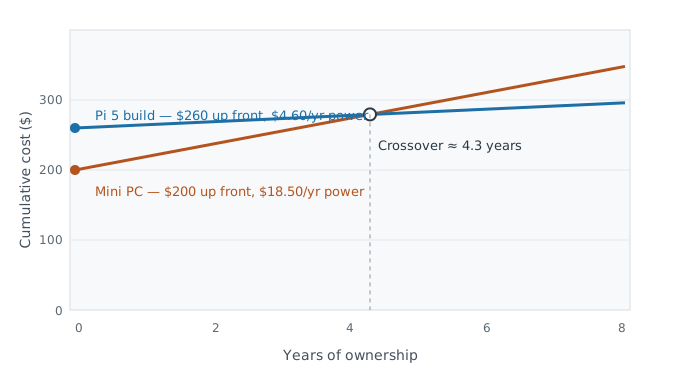
Defaults: Pi 5 8 GB ($95) plus $105 of extras = $260, against a $200 EQi12-class mini PC. Power: Pi at 3 W idle / 9 W load, mini PC at 12 W / 37 W, 2 load hours a day, $0.15/kWh. The Pi averages about 3.5 W and costs about $4.60 a year to run; the mini PC averages about 14.1 W and costs about $18.50. The gap is $14 a year — real money, but it means the $60 build premium takes about 4.3 years of electricity savings to repay, and only if you actually wanted the Pi's higher build cost in the first place. If your build lands at $200 too, the mini PC wins on price parity and the electricity gap is a rounding error, not a decision.
That sensitivity is the whole point. Power cost differences between these two form factors are structurally small because both are low-watt devices; capability differences are structural and permanent. Buy on workload first, and use this page to check that the power argument you read online is as decisive as it claimed.
Assumptions and limitations
- Pi idle and load presets come from third-party tests and owner reports, not our measurements. The official 27 W supply is the ceiling, not a typical draw.
- The two-state model (idle/load) smooths peaks such as disk spin-up, backup bursts and transcoding spikes.
- Board list prices are November 2026 and move; street prices vary by region and reseller. Extras default to $105 but a spare phone charger and an SD card you own can push a real build well under it.
- Nothing here prices the capability gap: x86-only container images, hardware video encoding, virtualisation and a 16 GB+ RAM ceiling are all mini-PC advantages that never appear on an electricity bill.
- No e-waste, replacement or resale value is modelled in either direction.
Frequently asked questions
How much does a usable Pi 5 build actually cost?
Typically $175–$260 once you add the 27 W supply, cooling, a case and NVMe storage — which lands it in the same band as a $200-class mini PC that arrives complete. The board price is not the build price, and the 16 GB board at $145 makes the high-RAM Pi build nearly as expensive as the x86 alternative.
Does the Pi's lower power draw ever pay back meaningfully?
Only at higher electricity rates or as part of a larger fleet. At $0.15/kWh the annual gap against a 12 W mini PC is roughly $12–16; at $0.40/kWh it approaches $45. A single box will not repay a $60–$100 build premium quickly, but a rack of twenty such boxes makes the arithmetic look different.
Why is the mini PC preset 12 W when spec sheets suggest less?
Because 12 W is what we measured at the wall with a real Docker stack running on our EQi12 — including the NVMe, both NICs, RAM and conversion losses. Spec-sheet numbers describe the CPU in isolation. The running-cost comparator explains the full method.
Should I just run the mini PC on a sleep schedule instead?
You can, and we publish measured wake data for exactly that pattern, but sleep schedules save single-digit dollars a year at these wattages and add a failure mode. The money argument in this tool assumes an always-on server, which is what most self-hosting setups want anyway.
What electricity rate should I enter?
Your marginal rate, not your average bill divided by kWh — taxes and fixed fees distort it. US averages sit near $0.15–$0.17/kWh, much of Europe runs $0.25–$0.40, and time-of-use plans can make a night-time server effectively cheaper than any single rate suggests.